Auto Insurance News
Introduction
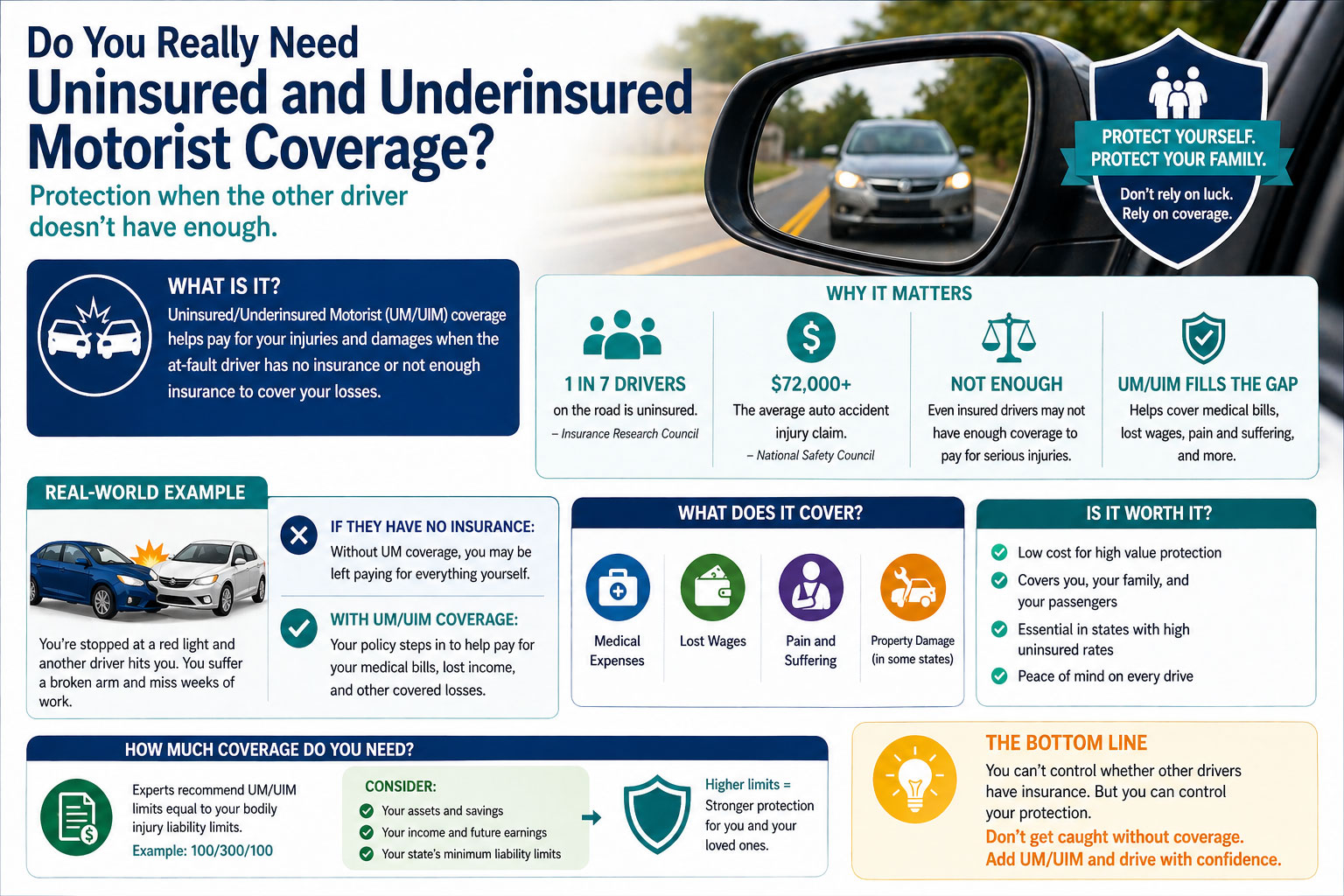
When you are reviewing your auto insurance policy or shopping for a new one, you will almost certainly be offered uninsured motorist coverage (UM) and underinsured motorist coverage (UIM). Some drivers add it without question. Others pass on it to save money, assuming the other driver’s insurance will take care of things if an accident happens.
The reality is that roughly one in eight U.S. drivers carries no auto insurance at all. Millions more carry only the state minimum, which may be as low as $10,000 in property damage liability. If one of those drivers causes a serious accident, their policy may cover only a fraction of your actual losses.
This guide explains who needs UM and UIM coverage, when it matters most, and how to decide on the right level of protection. You can compare quotes and coverage options at autoinsuranceplans.com to make an informed decision quickly.
What This Service Includes
How UM and UIM Work Together
Uninsured motorist coverage applies when the driver who caused your accident carries no insurance at all. Underinsured motorist coverage applies when the at-fault driver has insurance, but their limits are not high enough to cover your full losses. Together, these two coverages ensure that your financial protection does not depend on whether the other driver was responsible enough to carry adequate insurance.
Both UM and UIM can include bodily injury components, which pay for medical expenses, lost wages, and pain and suffering, and property damage components, which pay to repair or replace your vehicle.
What UM and UIM Do Not Cover
These coverages do not pay for damage you cause to others. They do not replace comprehensive coverage for events like hail, theft, or flooding. They do not cover mechanical breakdowns, routine maintenance, or accessories unless specifically included in your policy. They also do not eliminate the need for liability coverage, which protects other people when you are at fault.
Average Cost Overview
One of the strongest arguments for carrying UM and UIM coverage is the value it delivers relative to its cost.
| Driver Profile | UM/UIM Limits | Estimated Annual Cost |
| Young driver, urban area, state minimum limits | $25k/$50k | $75 to $120 |
| Middle-aged driver, suburban, standard limits | $100k/$300k | $100 to $180 |
| Family with two vehicles, high-limit stacked | $250k/$500k | $300 to $500 |
| Senior driver, rural area, standard limits | $100k/$300k | $80 to $150 |
| Driver in high uninsured-rate state (FL, MS, NM) | $100k/$300k | $150 to $260 |
These estimates reflect national averages and will vary based on your insurer, driving record, vehicle, and exact location. The low end of the range reflects low-risk drivers in states with lower uninsured motorist rates and simple, single-vehicle policies. The high end reflects urban drivers, high-risk states, stacked policies, and maximum limits.
Not sure which coverage level makes sense for your situation? Use www.autoinsuranceplans.com to compare real quotes from top-rated insurance companies and see exactly what you would pay for different UM and UIM limit combinations.
Key Cost Factors
- At-fault vs. no-fault states. In no-fault states, your own personal injury protection (PIP) covers your medical expenses regardless of fault. UM/UIM still matters in these states for serious accidents that exceed PIP limits or for property damage coverage.
- State uninsured motorist rates. Your premium is influenced by how many uninsured drivers operate in your state. High-risk states like Florida and Mississippi see more UM/UIM claims, which is reflected in pricing.
- Your income and financial exposure. If you earn a high income, an uninsured driver who causes you to miss weeks of work represents a much larger financial loss. UIM coverage for lost wages becomes correspondingly more valuable.
- Whether you carry collision coverage. If you have collision coverage, your vehicle is protected regardless of the other driver’s insurance status. This means UMPD is less critical for vehicle repairs, though it may still offer a lower deductible advantage.
- Family size and number of passengers. UMBI limits apply per person and per accident. Drivers who regularly carry passengers have more exposure if an uninsured driver causes a multi-injury accident.
- Your health insurance quality. Strong health coverage with low out-of-pocket maximums reduces the gap that UMBI needs to fill for medical expenses, though it does not address lost wages or pain and suffering.
- Local accident statistics. Urban areas with denser traffic typically see more accidents overall, which increases the probability of encountering an uninsured driver.
- Window replacement and vehicle damage. UMPD can cover broken windows and vehicle damage caused by an uninsured driver. Without it, you would pay out of pocket or file under collision, potentially triggering a deductible.
Ways to Save Money Without Cutting Corners
Understand what is truly optional in your state. In states where UM is required, your only real decision is how much coverage to carry. In states where it is optional, weigh the risk carefully before waiving it. The premium savings are rarely worth the financial exposure.
Stack only if you have multiple vehicles and high medical cost exposure. Stacking increases your protection but also your cost. It makes the most sense for families with multiple vehicles and higher income to protect.
Compare quotes across multiple carriers. Pricing for UM/UIM varies substantially between insurers. A carrier that is competitive on liability pricing may not be the best value for UM/UIM, and vice versa. Running a side-by-side comparison through autoinsuranceplans.com takes minutes and can reveal meaningful differences.
Review your coverage limits annually. As your income, family situation, and vehicle value change, your coverage needs change too. An annual review ensures you are not paying for coverage gaps or unnecessary extras.
Take advantage of safe driver programs. Many insurers offer telematics programs or safe driver discounts that reduce your overall premium, including the UM/UIM component.
Common Mistakes and Red Flags
Assuming the other driver is covered. This is the single most dangerous assumption a driver can make. One in eight drivers has no insurance. In some states, the rate is significantly higher.
Selecting bodily injury limits that do not cover your income. If you earn $75,000 per year and carry $25,000 in UMBI, a serious injury that keeps you out of work for a year is almost entirely uncovered by your UM policy. Match your limits to your actual financial exposure.
Ignoring the property damage component. Many drivers focus on bodily injury limits and overlook UMPD entirely. In a hit-and-run, UMPD may be your only protection for vehicle damage without paying a collision deductible.
Not reading the fine print on stacking. Some states allow stacking across vehicles. Others do not. Some policies allow inter-policy stacking. Others only allow intra-policy stacking. Understanding your state’s rules and your policy language prevents unpleasant surprises at claim time.
Letting coverage lapse to save money short term. A lapsed UM/UIM policy provides zero protection. If you are struggling with premium costs, contact your insurer about a payment plan or use autoinsuranceplans.com to find a more affordable policy rather than letting coverage lapse.
Choosing an insurer based only on price. A low premium means nothing if the company handles claims poorly. Check financial strength ratings from AM Best and customer service ratings before making your final decision.
Frequently Asked Questions
Do I need UM/UIM if I already have health insurance and collision coverage? Possibly, but there are still gaps. Collision covers vehicle damage but usually with a deductible. Health insurance covers medical bills but not lost wages or pain and suffering. UM/UIM bodily injury fills those gaps when an uninsured driver is at fault.
What happens if I am hit by an uninsured driver and I have no UM coverage? You would have to pursue the at-fault driver personally, which is often difficult and expensive. If they have no insurance, they likely have limited assets. Without UM coverage, you absorb the financial loss.
Does UM/UIM cover me as a passenger in another person’s car? Your own UMBI coverage may apply as secondary coverage when you are a passenger in someone else’s vehicle, depending on your state and policy. The car owner’s UM coverage is typically primary.
Can I reject UM/UIM coverage in writing? In states where it is optional or where rejection is allowed, yes. Insurers are required to offer it, but they must provide you a written waiver to sign if you decline. Be sure you understand what you are giving up before signing.
What if the at-fault driver’s insurer denies my claim? Your own UIM coverage can step in to cover losses while you or your attorney pursues the matter with the other insurer. This is one of the practical advantages of UIM.
How quickly does a UM/UIM claim get paid? Timelines vary. Simple property damage claims may resolve in days or weeks. Bodily injury claims involving ongoing treatment often take longer because the full extent of your injuries needs to be established before a settlement is reached.
Is UM/UIM coverage more important in some states than others? Yes. States with high uninsured driver rates, including Florida, Mississippi, New Mexico, Tennessee, and Michigan, represent higher real-world risk. Drivers in those states benefit most from strong UM/UIM limits.
Can I increase my UM/UIM limits mid-policy? Yes. You can typically adjust your coverage limits at any time. Changes usually take effect at renewal or immediately upon request, depending on your insurer.