
Auto Insurance News
Introduction
Full coverage auto insurance is one of the most commonly misunderstood terms in personal finance. Drivers often assume it means every possible cost in every possible situation is covered. The reality is more specific, and understanding exactly what full coverage does and does not include helps you make smarter decisions about your policy.
Most drivers consider full coverage when they buy a new or newer vehicle, when a lender or leasing company requires it, or when they want comprehensive financial protection against accidents and unexpected events. It is also worth revisiting when your vehicle ages and the math on maintaining full coverage starts to shift.
If you are trying to figure out whether full coverage makes sense for your situation, and what it would cost, comparing quotes from multiple companies is the fastest way to get real numbers. You can do that at autoinsuranceplans.com, where you can review options from multiple trusted insurance providers side by side.
What Full Coverage Auto Insurance Includes
The Three Core Components
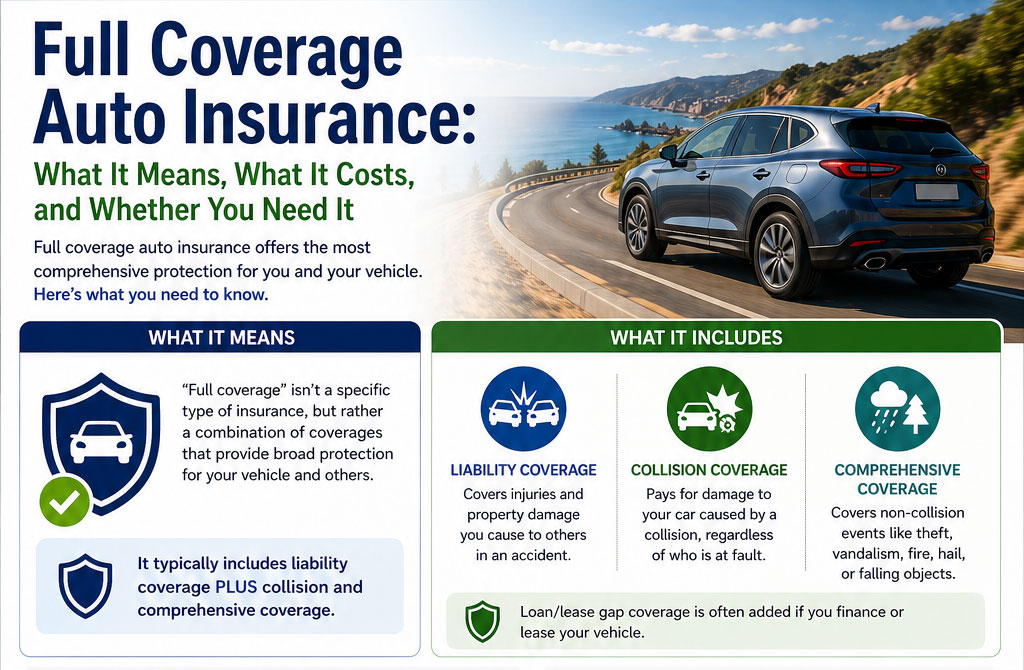
Full coverage is not a standardized product. It is a commonly used phrase that typically refers to a policy combining three types of coverage: liability, collision, and comprehensive.
Liability coverage protects other people when you cause an accident. It pays for their medical expenses, lost wages, and vehicle or property damage. Liability comes in two parts. Bodily injury liability covers injuries to other people. Property damage liability covers damage to their vehicle and any other property. Liability coverage does not pay for your own injuries or damage to your own vehicle.
Collision coverage pays for repairs to your own vehicle after a collision, regardless of fault. If you rear-end another car, get hit at an intersection, or slide off a road in winter weather, collision coverage handles your repair costs after your deductible is paid. Collision coverage requires you to choose a deductible, typically between $250 and $2,000.
Comprehensive coverage pays for damage to your vehicle from non-collision events. This includes theft, fire, flooding, hail damage, vandalism, falling objects like tree limbs, and collisions with animals. Comprehensive coverage uses the same deductible as collision, or you can choose a separate deductible for each.
What Is Typically Not Included
Despite the name, full coverage leaves out several things that drivers sometimes expect it to cover. Uninsured motorist protection, which pays when you are hit by a driver with no insurance or too little insurance, is a separate coverage that must be added specifically. Medical payments coverage and personal injury protection, which cover your own medical costs after an accident, are also separate additions. Roadside assistance, rental car reimbursement, and gap insurance are additional endorsements that are not part of a standard full coverage policy.
Full coverage also does not cover mechanical failures or breakdowns unrelated to a covered accident. It does not cover personal property stolen from inside the vehicle, which falls under homeowners or renters insurance.
Average Cost Overview
The cost of full coverage auto insurance depends heavily on your personal profile, your vehicle, and where you live. Here is a realistic breakdown of what drivers around the country typically pay.
| Coverage Level | Typical Annual Premium |
| Liability only, state minimum | $400 to $800 |
| Basic full coverage, high deductible | $900 to $1,400 |
| Standard full coverage | $1,400 to $2,200 |
| Full coverage with low deductible and add-ons | $2,200 to $3,800 |
The national average for full coverage auto insurance sits between $1,700 and $2,100 per year as of recent reporting. Monthly, that translates to roughly $140 to $175 for an average driver with a clean record, a standard vehicle, and mid-range deductibles.
At the lower end, you will find experienced drivers over 30 with clean records, older but still loan-free vehicles of moderate value, rural or suburban locations with lower accident and theft rates, higher deductibles of $1,000 or more, and bundled policies that include discounts.
At the higher end, you will find younger drivers especially those under 25, new or high-value vehicles, urban locations with high population density and traffic, recent at-fault accidents or violations, lower deductibles of $250 to $500, and luxury or sports vehicles with high repair costs.
Use autoinsuranceplans.com to compare real full coverage quotes for your specific driver profile and vehicle and see exactly what the market offers before you decide.
Key Cost Factors
Your deductible choice. The deductible is the single easiest lever you can pull to adjust your full coverage premium. Choosing a $1,000 deductible instead of a $250 deductible can reduce your collision and comprehensive premium by 20 to 30 percent. The trade-off is a higher out-of-pocket cost if you file a claim.
Liability limits. Standard minimum limits are often too low for drivers with assets to protect. Increasing your bodily injury liability from the state minimum to 100/300 adds cost to your premium but significantly increases your protection in a serious accident.
Vehicle age and value. Comprehensive and collision premiums are tied to the actual cash value of your vehicle. A vehicle worth $30,000 costs more to insure under full coverage than a vehicle worth $8,000. As your vehicle ages and its value drops, the cost-benefit calculation for maintaining full coverage changes.
At-fault accident history. An at-fault accident raises your full coverage premium more than it raises a liability-only premium because collision and comprehensive costs go up when the insurer views you as higher risk. A single at-fault accident can raise full coverage premiums by $500 to $1,000 or more per year depending on the insurer.
No-fault vs. at-fault state. Drivers in no-fault states like Florida, Michigan, New York, and New Jersey generally pay higher premiums because PIP coverage is required, and the no-fault system means your insurer pays your medical costs regardless of fault, increasing their exposure.
Credit history. In most states, your credit-based insurance score affects your premium directly. Drivers with excellent credit can pay 20 to 30 percent less than drivers with poor credit for identical coverage.
Garaging location. Where your vehicle is parked overnight matters. A vehicle garaged in a suburban driveway costs less to insure than the same vehicle parked on a street in a high-crime urban area. Moving to a different zip code can change your premium substantially.
Annual mileage. The more miles you drive, the more exposure you have to accidents. Low-mileage drivers often qualify for discounts, and some insurers offer pay-per-mile programs that can produce significant savings for drivers who average under 7,500 miles per year.
Ways to Save Money Without Cutting Corners
Evaluate whether full coverage is still cost-effective for your vehicle. A useful guideline is to compare your annual collision and comprehensive premium to the value of your vehicle. If the combined annual premium for those two coverages exceeds 10 percent of your car’s market value, and your car is paid off, dropping to liability only may be financially sound. Use Kelley Blue Book or NADA Guides to check your vehicle’s current value.
Compare quotes at every renewal. Insurance companies adjust their pricing regularly, and the company that offered you the best rate three years ago may not be offering the best rate today. Comparing quotes at least annually, and especially after major life changes, keeps your premium competitive.
Increase your deductible if you have savings to cover it. If you have a solid emergency fund, moving from a $500 to a $1,000 deductible on both collision and comprehensive can reduce your annual premium meaningfully without leaving you exposed in a claim.
Bundle home and auto insurance. Purchasing your homeowners or renters policy and your auto policy from the same insurer typically saves 5 to 15 percent on both policies. This is one of the most reliable and widely available discounts in the market.
Ask about every discount you might qualify for. Safe driver discounts, good student discounts, vehicle safety feature discounts, anti-theft device discounts, paperless billing discounts, and paid-in-full discounts are all commonly available and often not automatically applied unless you ask.
Enroll in a telematics program. If you are a safe, low-mileage driver, usage-based insurance can reduce your premium significantly. These programs track your speed, braking habits, and time of day driving through an app or device. Safe drivers typically see savings of 10 to 20 percent.
Common Mistakes and Red Flags
Assuming full coverage means everything is covered. Drivers sometimes file claims expecting full coverage to pay for things it does not include, like a cracked windshield in a state without mandatory glass coverage, or a stolen laptop from the back seat. Read your policy declarations page carefully to understand exactly what your coverage includes.
Keeping full coverage on a vehicle that is not worth it. Paying $900 per year in collision and comprehensive premiums on a vehicle worth $4,000 makes little financial sense. If the vehicle is totaled, the insurer will pay its actual cash value, not replacement cost. Do the math annually.
Choosing the lowest deductible without considering the premium impact. A $250 deductible on collision sounds protective, but if it costs you $400 more per year in premium than a $1,000 deductible, you are paying a steep price for that lower threshold. Consider how often you realistically expect to file a collision claim.
Not adding uninsured motorist coverage to a full coverage policy. With roughly 13 percent of U.S. drivers uninsured, the risk of being hit by an uninsured driver is real. A full coverage policy without uninsured motorist coverage leaves a gap that can be costly.
Letting the policy auto-renew without reviewing it. Rates can change at renewal for reasons that may or may not apply to you, such as changes in the insurer’s loss experience in your area. Always review your renewal notice and compare it against quotes from other companies.
Frequently Asked Questions
Is full coverage required by law? No. State laws require liability coverage, not full coverage. Full coverage is required by lenders and leasing companies when you have a car loan or lease. Once the loan is paid off, full coverage becomes optional.
What is gap insurance and do I need it with full coverage? Gap insurance covers the difference between what you owe on a car loan and the actual cash value of the vehicle if it is totaled. New vehicles depreciate quickly, so the loan balance can exceed the car’s value for the first few years. If you financed a new vehicle with little or no down payment, gap insurance is worth considering.
How is the actual cash value of my car determined? Insurers use market data, including comparable vehicle sales in your area, mileage, condition, and vehicle history, to determine actual cash value at the time of a total loss. This amount may be lower than you expect, especially for vehicles with high mileage or above-average wear.
Does full coverage include a rental car if mine is being repaired? Not automatically. Rental car reimbursement is a separate endorsement that must be added to your policy. It typically costs $10 to $30 per year and pays for a rental while your vehicle is being repaired after a covered claim.
Will my full coverage policy pay for a cracked windshield? Comprehensive coverage covers glass damage including windshields, but your deductible applies unless your state requires zero-deductible glass coverage or you have added a specific glass endorsement to your policy.
How soon after buying a car do I need full coverage? If you are financing or leasing, the lender requires coverage before you drive the vehicle off the lot. If you are paying cash, you should have coverage in place before you drive it. Most insurers allow you to add a vehicle mid-policy.
Can I switch from full coverage to liability only mid-policy? Yes, in most cases you can adjust your coverage at any time by contacting your insurer. If your vehicle is financed, reducing coverage below what the lender requires will violate your loan agreement.
What happens if my car is totaled and I only have full coverage without gap insurance? Your insurer will pay you the actual cash value of the vehicle. If you owe more on the loan than that amount, you are responsible for paying the difference out of pocket unless you have gap insurance.