Auto Insurance News
Introduction
Choosing between liability coverage and full coverage is one of the most financially significant decisions a car owner makes. Get it wrong in one direction and you are overpaying for coverage your situation does not need. Get it wrong in the other direction and a single accident could cost you thousands of dollars out of pocket.
This guide gives you a complete, honest breakdown of both options: what they cover, what they cost, and how to decide which one fits your life right now. It is written for everyday car owners in plain language, with no insurance jargon left unexplained.
When you are ready to compare real prices from actual insurers based on your profile, visit autoinsuranceplans.com to get side-by-side quotes in minutes.
What This Service Includes
Liability Coverage Defined
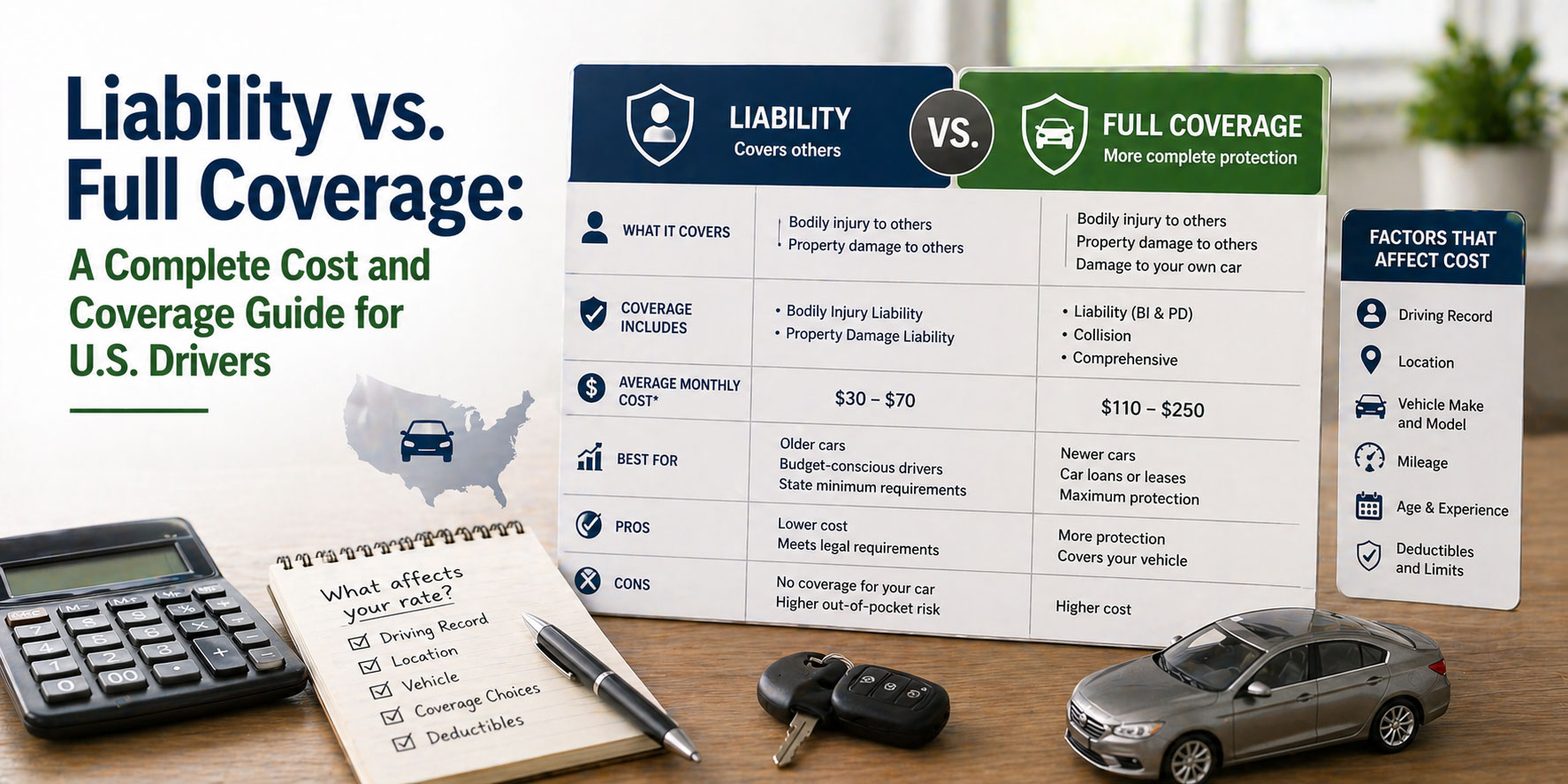
Liability coverage is the foundation of any auto insurance policy. It pays for the harm you cause to other people and their property when you are at fault in an accident. It covers two things.
Bodily injury liability pays for the medical expenses, rehabilitation costs, lost wages, and legal defense if you are sued by someone you injured in an accident. Property damage liability pays for repairs to vehicles, fences, buildings, or other property you damaged.
Liability coverage does not pay for your own injuries or your own vehicle. It protects others from your mistakes.
Full Coverage Defined
Full coverage adds collision and comprehensive protection on top of liability. Together, the three parts create a policy that addresses nearly every financial risk connected to owning and driving a vehicle.
Collision coverage pays for your vehicle’s repair or replacement after an accident involving another vehicle or an object like a guardrail, a tree, or a building. Comprehensive coverage pays for damage to your vehicle caused by theft, fire, flooding, hail, falling objects, and animal strikes.
What Is Not Automatically Included in Either
Regardless of whether you carry liability only or full coverage, the following are typically separate add-ons:
- Personal injury protection or medical payments coverage
- Uninsured and underinsured motorist coverage (required in some states, optional in others)
- Rental car reimbursement
- Roadside assistance
- GAP insurance for financed vehicles
- Rideshare coverage
Average Cost Overview
The cost gap between liability-only and full coverage is real and meaningful. Below are typical annual cost ranges for U.S. drivers in 2025.
| Policy Type | Typical Annual Cost |
| Liability only, state minimum limits | $400 to $700 |
| Liability only, recommended limits | $600 to $1,000 |
| Full coverage, vehicle under $15,000 | $900 to $1,400 |
| Full coverage, vehicle $15,000 to $35,000 | $1,300 to $1,900 |
| Full coverage, vehicle over $35,000 | $1,800 to $3,500+ |
| Full coverage, driver under 25 | $2,200 to $5,000+ |
The low end of these ranges typically applies to drivers over 30 with clean records, moderate-value vehicles, higher deductibles, and residency in lower-cost states such as Iowa, Maine, or Ohio. The high end reflects young drivers, urban residents in high-cost states, drivers with recent violations or claims, and those insuring expensive or high-theft-risk vehicles.
State of residence is one of the most powerful pricing factors. Michigan drivers pay the highest average premiums in the country, frequently exceeding $2,500 per year for full coverage, while Iowa drivers often pay under $1,000 for comparable coverage.
Ready to stop guessing and see your actual number? Visit autoinsuranceplans.com to compare quotes from licensed insurers in your state and find a policy that fits your budget.
Key Cost Factors
Deductible Selection
For full coverage policies, the deductible you choose for collision and comprehensive directly affects your premium. A $250 deductible provides more first-dollar protection but costs more monthly. A $1,000 deductible lowers your premium meaningfully but requires you to cover more out of pocket when you file a claim.
Choosing the right deductible depends on your savings and how often you are likely to file claims. Drivers with stable emergency funds generally benefit from higher deductibles.
Coverage Limits
Higher liability limits cost more but protect you from personal financial exposure after a serious accident. Most insurance professionals recommend carrying at least 100/300/100, which means $100,000 per person in bodily injury, $300,000 per accident in bodily injury, and $100,000 in property damage. State minimums are often set far below these amounts.
At-Fault vs. No-Fault State
In at-fault states, the driver who caused the accident pays for the other party’s damages through their liability coverage. In no-fault states, each driver’s own insurer pays for their medical expenses regardless of fault. No-fault states require personal injury protection coverage, which adds to the total cost of any policy.
No-fault states include Florida, Michigan, New York, New Jersey, Pennsylvania, and several others. Drivers in these states carry higher minimum requirements and typically pay more overall.
Driving Record
At-fault accidents, speeding tickets, and other violations stay on your driving record for three to five years and raise your premiums during that period. A single at-fault accident can increase a full coverage premium by 20 to 40 percent. A DUI conviction can result in rate increases of 50 to 100 percent or more.
Vehicle Age, Value, and Type
Collision and comprehensive premiums are tied directly to your car’s value. Newer, more expensive vehicles cost more to insure under full coverage. Vehicles with high theft rates or expensive parts also carry higher premiums. A 10-year-old sedan with a market value of $8,000 costs far less to insure than a new SUV worth $45,000.
Credit Score
In most states, insurers use a credit-based insurance score as one pricing factor. This score is distinct from a standard credit score but is influenced by similar factors such as payment history and outstanding debt. Drivers with excellent credit can pay 20 to 30 percent less than comparable drivers with poor credit, depending on the state and insurer.
Annual Mileage
Low-mileage drivers present less statistical exposure to accidents. Many insurers offer discounts for drivers under 7,500 to 10,000 miles per year. Pay-per-mile insurance programs, offered by companies like Metromile and some major insurers, can provide significant savings for infrequent drivers.
Ways to Save Money Without Cutting Corners
Understand What You Actually Need
Liability is required. Collision and comprehensive are optional unless your vehicle is financed or leased. Evaluate your car’s current market value honestly. If it has depreciated significantly, dropping collision may save you several hundred dollars per year without meaningfully reducing your financial security.
Compare Quotes at Every Renewal
Insurance markets are competitive and pricing shifts constantly. The insurer offering the lowest rate today may not be competitive next year. Comparing three to five quotes at each annual renewal is one of the highest-return activities a car owner can do.
Use autoinsuranceplans.com to run comparisons quickly across multiple insurers without the time investment of contacting each one separately.
Bundle Policies
Combining your auto insurance with a home, renters, or condo policy with the same insurer typically earns a discount of 5 to 25 percent. Multi-vehicle discounts are similarly available for households insuring more than one car.
Ask About All Available Discounts
Do not assume your insurer is applying every discount you qualify for. Common discounts include good driver, defensive driving course, low mileage, good student, vehicle safety features, loyalty, and paperless billing. Asking about available discounts directly can uncover savings you did not know existed.
Use Telematics to Prove Safe Driving
Many insurers offer telematics programs that monitor your driving through a smartphone app or vehicle device. Drivers who demonstrate safe habits, smooth braking, reasonable speeds, and daytime driving, can earn discounts of 10 to 30 percent with some programs.
Raise Your Deductible Strategically
If you have savings to cover a $1,000 deductible comfortably, raising from $250 or $500 can reduce your full coverage premium meaningfully. Just make sure the deductible amount is accessible and not locked up in investments or restricted accounts.
Common Mistakes and Red Flags
Carrying state minimum liability without understanding the risk. Minimum liability limits are often inadequate for a serious accident. A multi-vehicle collision or a pedestrian injury can easily produce medical costs exceeding $200,000. If your limits are $25,000 per person, you are personally responsible for the rest.
Not updating coverage after paying off a car loan. When you pay off your car, the lender’s collision and comprehensive requirement disappears. Many drivers forget to review whether keeping full coverage still makes financial sense on a now-older, lower-value vehicle.
Letting coverage lapse for even a short period. A gap in coverage is visible to other insurers when you shop for a new policy. Drivers with a lapse are viewed as higher risk and charged higher premiums. Set up autopay to avoid an unintentional lapse.
Not carrying uninsured motorist coverage. Roughly one in eight U.S. drivers is uninsured. If an uninsured driver causes an accident and you only have liability coverage, you have no protection for your own vehicle or injuries. Uninsured motorist coverage is inexpensive and provides important protection.
Choosing a policy solely based on price. A low premium from an insurer with a poor claims handling reputation can cost you far more in frustration and delays when you actually need to file a claim. Check customer satisfaction ratings and financial strength ratings before buying.
Overlooking the impact of a deductible on small claims. Filing a collision claim for $700 with a $500 deductible nets you $200 from the insurer but may trigger a premium increase at renewal. Understanding this math before filing helps you make smarter decisions.
Frequently Asked Questions
What is the minimum car insurance required in my state? Every state has different minimum liability requirements. Most require at least some level of bodily injury and property damage liability. States like California require 15/30/5 while New York requires 25/50/10. No-fault states add personal injury protection requirements. Check your state’s department of insurance website for the specific minimums that apply to you.
Do I need full coverage if my car is old? Not necessarily. If your car’s market value is low, the maximum collision payout after your deductible may not justify the ongoing cost. Use your car’s current actual cash value and your annual premium to calculate whether keeping collision makes financial sense.
What does 100/300/100 liability mean? It means your policy covers up to $100,000 per person for bodily injury, up to $300,000 per accident for bodily injury across all parties, and up to $100,000 for property damage you cause. These are widely recommended as minimum adequate limits for most drivers.
Does full coverage pay for everything if I am in an accident? Full coverage covers vehicle damage broadly, but it still has limits, deductibles, and exclusions. It does not automatically cover your medical bills, rental car costs, or the gap between your car’s value and your loan balance. Add-on coverages address those specific gaps.
How do I know if my liability limits are high enough? Consider your assets. If you are sued after a serious accident and your liability limits are exhausted, the injured party can pursue your personal assets including savings, investments, and property. If you have meaningful assets, higher liability limits and possibly an umbrella policy provide important protection.
Can I switch from full coverage to liability only midway through my policy term? Yes, if your vehicle is paid off. Contact your insurer to make the change. You will typically receive a prorated refund for the unused collision and comprehensive premium. Make sure the car is not currently financed before making this change.
Why did my premium go up at renewal if I had no accidents? Premiums can rise for many reasons beyond your individual record: overall rate increases in your state, changes in your credit score, vehicles you insure aging into higher-cost categories, or changes in your insurer’s pricing model. Comparing quotes at renewal is the best response to an unexpected increase.
Does full coverage cover damage from a natural disaster? Yes, through the comprehensive portion of a full coverage policy. Flood damage, hail, wind, and other weather-related events are covered under comprehensive. Collision only covers impact-related damage.
Is liability coverage cheaper than full coverage everywhere? Yes. Liability-only is always less expensive than full coverage because it covers less. The difference in cost depends on your vehicle’s value, your deductible choices, and your location, but full coverage will always cost more than liability only.
How can I get the best price on full coverage? Maintain a clean driving record, keep your credit in good standing, compare multiple quotes at each renewal, bundle your policies, and choose the highest deductible you can comfortably cover in an emergency. Starting your comparison at autoinsuranceplans.com gives you access to multiple insurers in one place.