Auto Insurance News
1. Introduction
Choosing between liability and full coverage is the most significant decision a car owner makes when setting up a policy. This choice dictates how much you pay every month and how much protection you have after a wreck. Liability insurance is the legal baseline required by almost every state. It protects other people from the damage you cause. Full coverage is a broader term that includes protection for your own vehicle.
People usually need to evaluate these options when they purchase a new vehicle, when an old car starts to lose value, or when they move to a state with different legal requirements. If you are currently unsure which level of protection fits your budget, you can use autoinsuranceplans.com to compare quotes from insurance companies. This comparison allows you to see the exact price difference between a basic legal policy and a plan that protects your own investment.
2. What This Service Includes
Understanding the terminology is the first step toward making a smart purchase. Insurance agents use these terms daily, but for a consumer, they can be misleading.
What is typically included in Liability Insurance
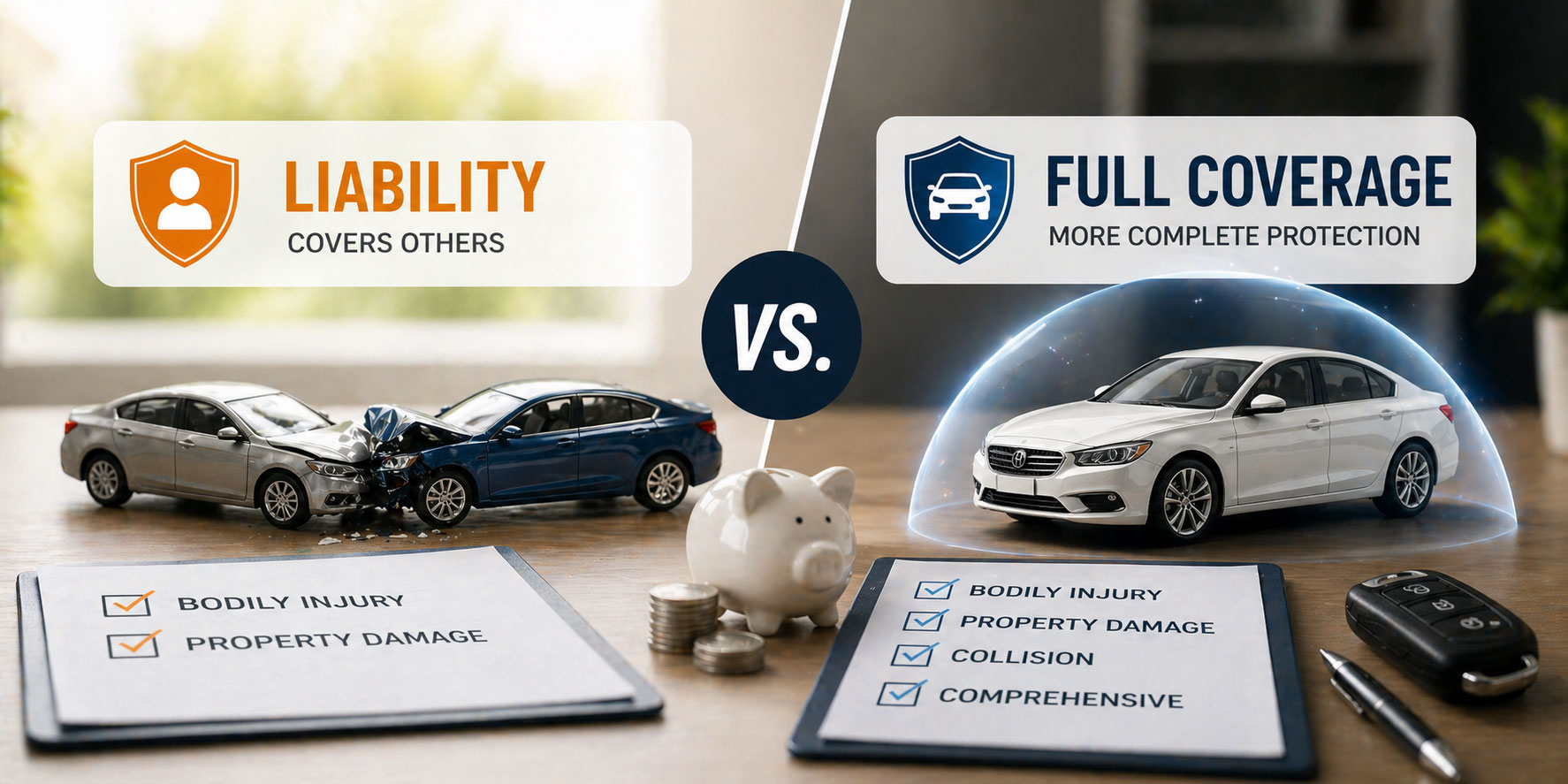
Liability insurance is designed to protect your financial assets if you are found at fault in an accident. It consists of two primary parts. The first is Bodily Injury Liability. This pays for the medical bills, rehabilitation, and even lost wages of the people you hit. It also covers your legal defense if those individuals decide to sue you. The second part is Property Damage Liability. This pays to repair or replace the other person’s car, fence, or storefront that you damaged with your vehicle.
Liability insurance is the “selfless” part of your policy. It does not pay for your own injuries or your own car repairs. It is strictly there to satisfy your legal obligation to others.
What is typically included in Full Coverage
The term “full coverage” is actually an industry nickname. It typically refers to a policy that combines state-mandated liability with two additional types of protection: Collision and Comprehensive.
Collision coverage pays to fix your car if you hit another vehicle or a stationary object like a tree. Comprehensive coverage protects your car from “acts of God” or non-collision events. This includes theft, fire, vandalism, hailstorms, and hitting an animal. When you have full coverage, you are protected regardless of whether you caused the accident or if your car was damaged while parked in your driveway.
What is usually extra or not included
Even a full coverage policy has limits. Things like roadside assistance, which pays for a tow truck or a battery jump, are usually optional add-ons. Rental car reimbursement, which provides a vehicle while yours is in the shop, is also an extra cost. Most importantly, standard policies do not include “gap insurance.” This is a specific type of coverage that pays the difference between what your car is worth and what you owe on your loan if the car is totaled.
3. Average Cost Overview
The price of insurance is highly individualized, but there are clear patterns between liability and full coverage. Liability is always the cheaper option because the insurance company is taking on less risk.
Typical price ranges
- Typical low price range (Liability): $450 to $800 per year.
- Typical average price range (Full Coverage): $1,600 to $2,400 per year.
- Typical high price range (High-risk drivers): $3,000 to $5,000+ per year.
Policy cost summary table
| Service Option | Typical Annual Price Range | Typical Monthly Cost |
| Basic Liability (Minimum) | $450 to $950 | $37 to $79 |
| Mid-Range Liability (Increased limits) | $800 to $1,400 | $66 to $116 |
| Full Coverage (Standard Deductibles) | $1,600 to $2,800 | $133 to $233 |
The low end of these ranges is usually reserved for drivers over age 30 with clean driving records and high credit scores. The high end is driven by drivers under age 25, residents of high-traffic cities, or those with a history of accidents and speeding tickets.
Ready to move forward? Use www.autoinsuranceplans.com to compare quotes from trusted local auto insurance companies so you can secure a policy with confidence.
4. Key Cost Factors
Several variables change the price of your policy. Understanding these helps you manipulate the numbers to find a price you can afford.
- Deductible: This is the amount you pay out of pocket before the insurance company pays for repairs. A higher deductible, like 1,000 dollars, will lower your monthly full coverage premium. A low deductible, like 250 dollars, will make your monthly premium much higher.
- Amount of Coverage: If you choose the absolute minimum liability required by your state, your price will be low. However, if you hit an expensive SUV and only have 10,000 dollars in property damage coverage, you will be responsible for the rest of the bill.
- Window Replacement: Some states require “full glass” coverage to be included in comprehensive plans. If you live in a state where this is optional, adding it will slightly increase your premium but eliminate the cost of a new windshield.
- At-Fault History: If you have been found at fault for an accident in the last three to five years, you will pay a “surcharge.” This can increase your liability costs by 30 percent or more.
- No-Fault State Laws: If you live in a no-fault state like Florida or Michigan, you are required to buy Personal Injury Protection (PIP). This makes the baseline “minimum” insurance much more expensive than in “tort” states.
- Vehicle Type: Full coverage costs much more for a brand-new sports car than for a five-year-old family sedan. The insurance company looks at the cost of parts and labor for your specific model.
5. Ways to Save Money Without Cutting Corners
You do not have to settle for the first price you receive. There are practical ways to reduce your costs without losing essential protection.
Understand required versus optional coverage
The biggest savings come from knowing when to drop full coverage. If your car is worth less than 3,000 dollars, the amount you pay for collision and comprehensive insurance over two years might be more than the car is worth. In this case, switching to liability-only can save you over 1,000 dollars a year. However, if you have a loan or lease, your bank will require you to keep full coverage.
Comparing multiple quotes
Insurance companies use different math to decide your price. One company might penalize a speeding ticket heavily, while another might care more about your credit score. By using a comparison tool, you can find the specific company that favors your demographic. This is the single most effective way to save money on a policy.
6. Common Mistakes and Red Flags
One frequent mistake is choosing the state minimum liability limits. Many states only require 15,000 or 25,000 dollars for bodily injury. In a major accident, a single hospital stay can exceed 50,000 dollars. If your insurance is too low, the victim can sue you for your house or garnish your wages.
Another red flag is “ghosting” your insurance company about where you live. If you tell them you live in a rural area to get a lower rate but actually live in a city, they can deny your claim for “material misrepresentation.” This leaves you with no protection when you need it most.
7. Frequently Asked Questions (FAQ)
Is full coverage required by law?
No. No state requires full coverage. However, if you have a car loan or a lease, the lender will contractually require you to carry it until the vehicle is paid off.
How long does it take to get insurance?
You can usually get a policy active in about 15 to 30 minutes online. Once you make your first payment, the company will provide a digital insurance card immediately.
Does liability insurance cover a cracked windshield?
No. Liability only covers damage to other people’s property. You need comprehensive coverage to pay for your own windshield replacement.
What is the “Actual Cash Value” in full coverage?
If your car is totaled, the insurance company does not give you enough money to buy a brand-new car. They give you what the car was worth the second before the accident.
Will my rates go up if someone hits me?
If you are 100 percent not at fault, your rates typically will not go up in most states. However, some companies may remove a “claims-free” discount.
Can I switch from full coverage to liability at any time?
Yes. You can change your coverage levels whenever you want. If you have already paid for the month, the insurance company will usually refund the difference.