
Auto Insurance News
Introduction
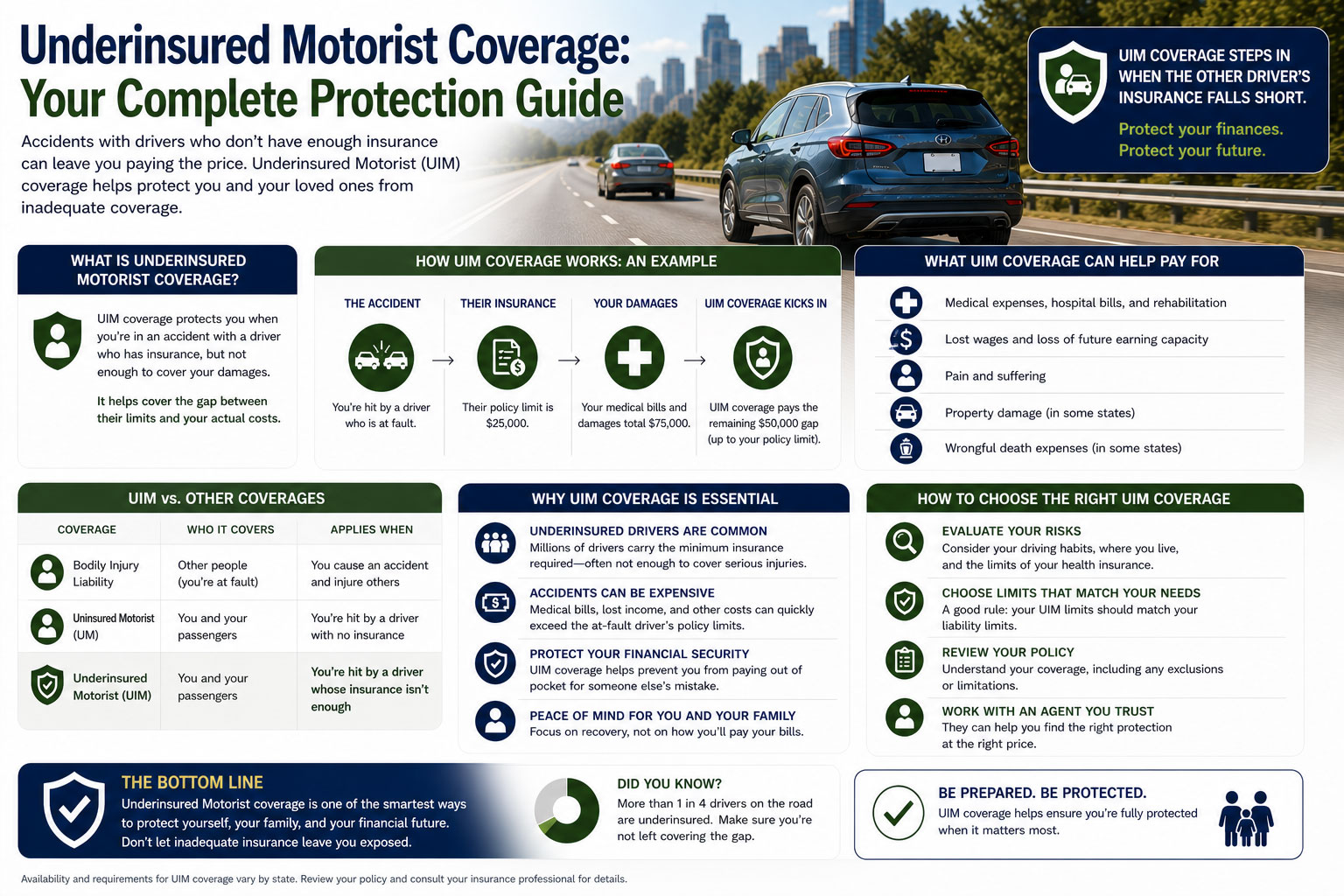
Every day, drivers are involved in accidents caused by someone who technically has insurance but nowhere near enough to cover the actual costs. A driver carrying only the state minimum liability policy might have $15,000 or $25,000 in bodily injury coverage. If you sustain serious injuries, that amount disappears quickly, leaving you to cover the remaining bills yourself. This is where underinsured motorist coverage, known as UIM, becomes essential.
Underinsured motorist coverage is the companion to uninsured motorist coverage. Where UM protects you against drivers with no insurance at all, UIM protects you against drivers who have some insurance but not enough. Together, UM and UIM form a safety net that protects you from the financial decisions of other drivers.
If you live in a state where many drivers carry only minimum liability limits, you are more exposed than you might think. This guide walks through how UIM coverage works, what it costs, and how to decide on the right limits. You can compare options right now at autoinsuranceplans.com.
What Underinsured Motorist Coverage Includes
Core Definition
Underinsured motorist coverage pays the difference between what the at-fault driver’s insurance covers and the actual cost of your damages, up to your own UIM limits. It does not duplicate the other driver’s coverage. It supplements it when that coverage falls short.
For example, if you suffer $80,000 in medical expenses and the at-fault driver carries only $25,000 in liability, their insurer pays $25,000 and your UIM coverage pays up to an additional $55,000, depending on your UIM limit.
What Is Typically Included
- Underinsured Motorist Bodily Injury (UIMBI): Covers medical expenses, rehabilitation costs, lost wages, and pain and suffering for you and your passengers when the at-fault driver’s liability limits are insufficient.
- Underinsured Motorist Property Damage (UIMPD): Available in some states, this covers your vehicle repair costs when the at-fault driver’s property damage liability is not enough. It is less common than UIMBI and varies by state.
- Coverage typically extends to family members living in your household, even when riding in another vehicle.
- Passengers in your vehicle at the time of the accident are usually covered.
- In some states, UIM coverage also applies to accidents you experience as a pedestrian or cyclist.
What Is Usually Not Included
- Accidents you cause yourself. UIM only applies when another at-fault driver’s coverage is insufficient.
- Situations where the at-fault driver has no insurance at all. That is handled by UM coverage, not UIM.
- Damage to vehicles you do not own or are not listed on your policy.
- Commercial vehicle accidents may be handled differently depending on the policy.
Average Cost Overview
UIM coverage is typically priced similarly to UM coverage and is often sold alongside it as a paired product. Some insurers bundle UM and UIM together; others price them separately. The figures below reflect typical annual additions to a standard policy.
Coverage Option Typical Annual Price Range
Basic UIM (25/50K limits) $45 to $85 per year
Mid-Range UIM (50/100K limits) $85 to $150 per year
High Coverage UIM (100/300K limits) $150 to $260 per year
UIMPD (Property Damage) $15 to $50 per year
Bundled UM + UIM Package $100 to $550 per year
As with UM coverage, costs vary by state, insurer, and personal factors. States with higher rates of underinsured drivers and more litigation around injury claims, such as Florida, Louisiana, and New Jersey, tend to produce higher UIM premiums. Drivers in lower-risk states with good driving records may find the cost is minimal, often under $10 per month.
Compare underinsured motorist coverage options today at www.autoinsuranceplans.com. Get quotes from multiple trusted insurers and choose the protection level that fits your needs and budget.
Key Cost Factors
Variables That Affect Your UIM Premium
- Your existing liability limits: In most states, your UIM limits cannot exceed your own liability limits. If you carry 50/100 liability, your UIM is typically capped at the same level unless you raise your liability first.
- State laws on trigger and offset: Some states use a tort-reduction trigger, meaning your UIM only pays if your damages exceed the total of the at-fault driver’s limits. Others use a limits trigger, which pays any time the at-fault driver’s limits are lower than yours, regardless of total damages. The tort-reduction approach tends to result in lower premiums.
- Stacking availability: Just like UM, some states allow stacking of UIM limits across multiple vehicles. Stacked coverage costs more but provides higher total coverage per accident.
- Deductible: UIMPD may carry a deductible. Higher deductibles mean lower premiums on the property damage portion.
- Driving record and claims history: Clean records attract better rates. Prior claims and violations push premiums higher across all coverage types.
- Vehicle type: Newer, more expensive vehicles tend to carry slightly higher UIMPD rates. UIMBI pricing is more heavily influenced by your health and injury risk profile.
- Geographic location: Dense urban areas with more traffic, higher accident rates, and higher medical costs typically generate higher UIM premiums.
Ways to Save Money Without Cutting Corners
Understanding What Is Required vs. Optional
A smaller number of states mandate UIM coverage compared to UM. In most states, UIM is optional but strongly recommended. If the at-fault driver in your last major accident had only minimum limits, you would have had no protection beyond what their policy covered, unless you had UIM.
Skipping UIM to save $8 to $15 per month is a decision many drivers regret after a serious accident. The practical financial exposure from a severe underinsured crash can reach six figures. The premium savings rarely justify the risk.
Smart Strategies to Reduce Your Premium
- Bundle UM and UIM together: Most insurers price UM and UIM as a package. Bundling them is almost always cheaper than purchasing them separately.
- Match your limits to your assets: Choose UIM limits that protect your financial situation. If you have significant assets, higher limits protect you in the event of a large civil action.
- Raise your collision deductible instead: If you want to reduce total premium cost, raising your collision deductible is often a better trade-off than reducing your UIM limits.
- Compare quotes at renewal: UIM pricing changes annually. Use autoinsuranceplans.com to shop multiple companies at renewal to ensure you are not overpaying.
- Take a defensive driving course: Many states and insurers offer discounts of 5 to 10 percent for completing a certified defensive driving course, which applies across your entire premium.
Common Mistakes and Red Flags
- Confusing UIM with UM: These are related but distinct. UM applies when the at-fault driver has no insurance. UIM applies when they have some but not enough. You typically need both.
- Choosing limits below your liability limits: Carrying lower UIM limits than your liability limits creates a gap. It makes little sense to protect others more generously than you protect yourself.
- Not understanding the offset rules in your state: In states with offset provisions, your UIM payout is reduced by the amount you already received from the at-fault driver. Understanding this before you buy helps you choose limits that account for the offset.
- Waiting to file a claim: UIM claims have reporting deadlines. Missing them can result in denied claims. Always report an accident promptly.
- Settling with the at-fault driver’s insurer too quickly: If you accept a settlement from the at-fault driver’s insurer without first notifying your own insurer of a potential UIM claim, you may lose your right to pursue UIM benefits.
- Ignoring medical payments or PIP interaction: In some states, medical payments or personal injury protection (PIP) benefits you receive may reduce your UIM recovery. Understanding how these interact helps you avoid surprises.
Frequently Asked Questions
How is UIM different from UM coverage?
UM coverage activates when the at-fault driver has absolutely no insurance. UIM coverage activates when the at-fault driver has insurance but their limits are lower than your actual damages or lower than your UIM limits, depending on your state’s rules.
Can I carry different limits for UM and UIM?
In some states, yes. In others, UM and UIM limits must be equal. Many insurers default to the same limits for both. Ask your agent whether your state allows different limits and whether a split structure makes sense for your situation.
What if the at-fault driver has exactly the same limits I do?
In states using a limits trigger, your UIM may not activate because the other driver’s limits equal yours. In states using a tort-reduction trigger, UIM only activates if your damages exceed the at-fault driver’s limits. This is why understanding your state’s rules matters when selecting limits.
Does UIM cover lost wages?
Yes, UIMBI typically covers lost wages in addition to medical expenses when the at-fault driver’s liability is insufficient. The extent depends on your policy limits. If you earn a substantial income, higher UIM limits are worth considering.
How long do I have to file a UIM claim?
Time limits vary by state and insurer, but you should report any accident to your insurer promptly, ideally within a few days. UIM claims often involve a two-step process: first settling with the at-fault driver’s insurer and then pursuing your own UIM coverage for the remainder. Your insurer needs to be involved from the start.
Will UIM cover me if I am a passenger in someone else’s car?
Typically yes, if you are injured as a passenger and the driver of the car you were in was underinsured or not at fault. Your own UIM policy usually follows you as a named insured. The interaction with the vehicle owner’s policy can be complex, so verify with your agent.
What happens if my UIM limits are exceeded?
If your damages exceed your UIM limits, you can pursue the at-fault driver in civil court for the remaining balance. However, if the at-fault driver has few assets, recovery may be difficult. This is why carrying high enough UIM limits to cover serious injury scenarios is important.
Is UIM coverage worth it if I have good health insurance?
Yes, for several reasons. Health insurance typically does not cover lost wages, pain and suffering, or long-term rehabilitation in the same way UIM does. Health insurers may also have subrogation rights, meaning they can recover from your settlement what they paid on your behalf. UIM fills gaps that health insurance does not address.