
Auto Insurance News
Introduction
Two drivers living on the same street can pay drastically different amounts for auto insurance. One might pay $900 a year and the other $2,800, even if they drive similar vehicles and carry the same coverage levels. The reason comes down to the personal and vehicle factors that insurers use to assess risk and set your premium.
Understanding how your driver profile affects your rate is the most practical knowledge you can have when shopping for auto insurance. It tells you which factors are working in your favor, which ones are costing you money, and which ones you can actually change. It also helps you have more informed conversations with insurance companies and avoid policies that are priced unfairly for your situation.
The best way to know what your actual rate should be is to compare quotes from multiple companies. Insurers weigh the same factors differently, and the price spread between the highest and lowest quotes for the same driver can be significant. Start comparing at autoinsuranceplans.com to see what real options look like for your profile.
What Auto Insurance Rate Setting Includes
How Insurers Evaluate Risk
Insurance companies are in the business of predicting the likelihood and cost of future claims. Every factor they use in pricing is based on statistical data about which types of drivers, vehicles, and locations are associated with more frequent or more expensive claims.
When you apply for auto insurance, the insurer collects information about you, your vehicle, your driving history, and where you live. They run that information through their proprietary rating algorithm and produce a premium that reflects their assessment of your risk level.
Your premium is not arbitrary. It is a mathematical output based on your specific combination of risk factors. That is why two different companies can produce quotes that differ by hundreds of dollars for the exact same driver. Each company weights the factors differently based on their own claims data and actuarial experience.
What Is Included in a Standard Rate Assessment
A standard auto insurance rate evaluation includes your age and years of driving experience, your driving history including accidents and violations, your credit-based insurance score in states where it is permitted, the make, model, year, and value of your vehicle, your annual mileage estimate, your garaging address and zip code, your prior insurance history and any coverage gaps, the coverage types and limits you select, and any discounts you qualify for.
What Can Change Your Rate Outside of a Renewal
Your rate is not fixed between renewals in all circumstances. Adding a driver, purchasing a new vehicle, moving to a new address, filing a claim, or receiving a traffic violation can trigger a mid-term rate adjustment. In some cases, if your circumstances change significantly, it may be worth getting new quotes before your current policy renews.
Average Cost Overview
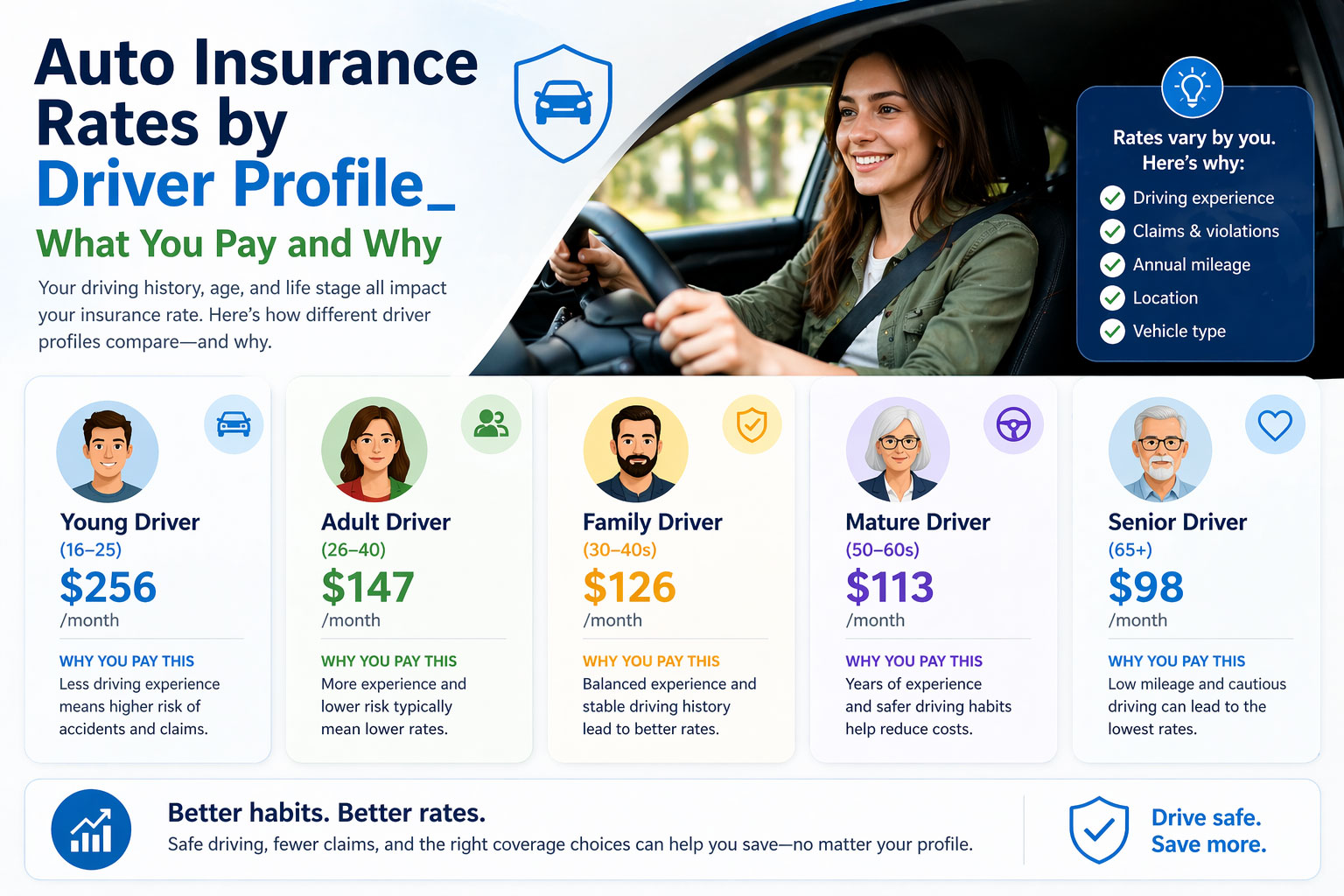
Auto insurance rates vary enormously by driver profile. Here is a realistic look at what different types of drivers typically pay for full coverage auto insurance annually.
| Driver Profile | Typical Annual Premium |
| Experienced driver, clean record, good credit | $900 to $1,400 |
| Average driver, one minor violation | $1,400 to $2,000 |
| Young driver age 18 to 25, clean record | $2,000 to $3,500 |
| Driver with one at-fault accident | $1,800 to $2,800 |
| Driver with DUI in the past 3 years | $2,500 to $4,500 |
| Senior driver age 70 plus | $1,200 to $2,200 |
These ranges reflect full coverage policies with standard deductibles. Liability-only policies will be 40 to 60 percent lower in most cases. Geographic location also plays a significant role. A clean-record driver in rural Iowa might pay $850 per year for full coverage, while the same driver profile in Miami, Florida might pay $2,100 for identical coverage.
The premium gap between the lowest and highest risk profiles reflects the statistical reality that high-risk drivers file significantly more and more expensive claims than low-risk drivers.
Ready to see where your profile lands? Compare quotes from multiple providers at autoinsuranceplans.com and get a realistic picture of your options.
Key Cost Factors
Age and driving experience. Teen drivers aged 16 to 19 have the highest accident rates of any group and pay the highest premiums accordingly. Rates decrease significantly through the mid-20s and continue to improve into the 30s and 40s. After age 70, reaction times, vision, and other factors begin to affect accident rates again, and premiums may rise.
At-fault accidents. An at-fault accident typically raises your premium by 30 to 50 percent and the increase stays on your record for three to five years depending on the insurer and state. Multiple at-fault accidents in a short period can make it difficult to find coverage from standard insurers at all.
Traffic violations. Speeding tickets, reckless driving charges, and running red lights all increase your premium. Minor violations typically add 10 to 20 percent to your rate. Major violations like reckless driving or racing can add 50 percent or more. DUI or DWI convictions carry the highest rate penalty of any single violation and can more than double your premium.
No-fault state requirements. If you live in a no-fault state, your insurer pays your medical bills after an accident regardless of who caused it. This requirement, combined with higher rates of fraud and litigation in some no-fault states, drives premiums higher. Michigan has historically had the highest average auto insurance premiums in the nation partly because of its no-fault system, though recent reforms have begun to bring rates down.
Vehicle theft rates. Certain vehicles are stolen far more frequently than others. High-theft vehicles cost more to insure under comprehensive coverage. The National Insurance Crime Bureau publishes annual lists of the most stolen vehicles in the U.S. Checking where your vehicle falls on that list gives you a sense of how theft risk affects your comprehensive premium.
Prior insurance history. Drivers who have maintained continuous coverage pay less than drivers with gaps in their insurance history. Insurers treat a lapse as a signal that the driver may be higher risk or less financially stable. Even a gap of 30 to 60 days can raise your rate with a new insurer.
Marital status. Married drivers statistically have fewer accidents than single drivers and in most states receive a modest rate advantage. The difference is not dramatic but is a real factor in the pricing model.
Annual and commute mileage. The more you drive, the more exposure you have to accidents. Drivers who commute long distances pay more than drivers who work from home or drive primarily for personal errands. Many insurers now offer telematics-based programs that verify actual mileage and reward low-mileage drivers with premium reductions.
Ways to Save Money Without Cutting Corners
Maintain a clean driving record actively. Every year that passes without an accident or violation improves your rate profile. Driving defensively, obeying speed limits, and avoiding distractions are the most direct ways to keep your record clean and your premium low over time.
Improve your credit score. In most states, your credit-based insurance score has a direct impact on your premium. Paying bills on time, reducing credit card balances, and avoiding unnecessary new credit inquiries all improve your credit score over time and can translate into lower insurance rates at renewal.
Take a defensive driving course. Many insurers offer a discount of 5 to 10 percent for completing an approved defensive driving or driver safety course. In some states, a defensive driving course can also help remove points from your driving record after a minor violation.
Shop the market at every renewal. The auto insurance market is competitive and rates shift over time. An insurer that was most affordable for your profile two years ago may not be today. Getting three to five quotes at each renewal takes less than 30 minutes and can save you hundreds of dollars annually.
Ask about a good student discount. If a young driver on your policy maintains at least a B average, most insurers will reduce the rate for that driver by 8 to 15 percent. This is one of the more valuable discounts available for a driver profile that otherwise commands some of the highest premiums in the market.
Consider a higher deductible. For experienced drivers with clean records and a financial cushion, raising the collision and comprehensive deductible is a straightforward way to reduce the premium without reducing liability protection, which is the coverage most important for protecting your assets.
Common Mistakes and Red Flags
Not disclosing all drivers in the household. Every licensed driver in your household who has access to your vehicle should be listed on your policy. Failing to disclose a household driver, particularly a high-risk young driver, can result in a claim denial if that person is driving during an accident. It can also be considered material misrepresentation, which is a form of insurance fraud.
Underreporting annual mileage to get a lower rate. While it is tempting to estimate your mileage on the low end, significantly understating your mileage can create problems at claim time if the insurer determines the stated mileage was inaccurate. Be honest and precise when reporting mileage.
Ignoring rate increases at renewal without investigating. If your premium increases at renewal and your circumstances have not changed, the increase may be due to general rate adjustments in your area or changes in the insurer’s underwriting criteria. It is always worth calling your insurer to understand the increase and comparing it against quotes from other companies before simply accepting it.
Choosing a provider without checking their claims reputation. A low premium means little if the company is difficult to work with when you file a claim. Research the insurer’s ratings from J.D. Power, AM Best, and the National Association of Insurance Commissioners complaint database before committing to a policy.
Failing to remove drivers who no longer live in the household. If a young driver moves out or a household member no longer has access to your vehicles, removing them from your policy can produce meaningful premium savings. Policyholders sometimes forget to update their policies as circumstances change.
Not asking about reinstated discounts after improving your record. If violations or accidents that were raising your rate have aged off your record, your insurer may not automatically apply the improvement to your premium. Contact your insurer or shop the market to make sure your rate reflects your current record.
Frequently Asked Questions
How long does an at-fault accident stay on my insurance record? Most insurers look back three to five years for rating purposes. The accident typically stops affecting your premium after that window passes, though it may remain on your official driving record longer.
Can I be denied auto insurance because of my driving record? Yes. Standard insurers can decline to write a policy for drivers they consider too high risk. Drivers with multiple violations, DUI convictions, or a history of fraud may need to seek coverage from non-standard or assigned risk insurers. These policies cost more but provide the legal minimum required coverage.
Does my job or occupation affect my auto insurance rate? Some insurers do use occupation as a rating factor. Certain professions are statistically associated with lower claim rates and may receive a modest discount. Educators, engineers, scientists, and military personnel are among the groups that sometimes receive occupational discounts.
How does adding a teen driver affect my premium? Adding a teen driver to a policy typically increases the premium by $1,000 to $2,500 per year depending on the insurer, the vehicle assigned to the teen, and the teen’s driving record. This is one of the largest single factors that can change a household insurance premium.
If I move to a different state, do I need a new policy? Yes. Auto insurance policies are state-specific, and you are required to obtain a policy that meets your new state’s minimum coverage requirements. Notify your insurer of your move promptly, as coverage requirements and rates differ significantly between states.
Will taking a defensive driving course actually lower my rate? In most cases, yes. The discount varies by insurer and state, but 5 to 10 percent is typical. In some states, a course completion can also reduce points on your driving record, which can have a larger impact on your rate over time.
Can my insurer drop me after a claim? In most states, insurers can choose not to renew your policy at the end of a term if you have filed multiple claims or if your risk profile has changed significantly. They generally cannot cancel a policy mid-term except for reasons like non-payment, fraud, or license suspension. You must be given notice of non-renewal with enough time to find new coverage.
How do I know if my current rate is competitive? The most reliable way to know is to compare quotes from at least three other insurers. If competing quotes are significantly lower for the same coverage, your current insurer’s rate may not be competitive for your profile.
Your driver profile determines a large part of what you pay for auto insurance, but the insurer you choose determines the rest. The same profile can produce very different quotes from different companies, and the only way to know which insurer offers the best rate for you is to compare them directly.
Use autoinsuranceplans.com to compare quotes from trusted insurance companies. Get auto insurance that fits your profile, your budget, and your coverage needs.