Auto Insurance News
Introduction
Every driver in the United States is required to carry some form of auto insurance, but the type and amount of coverage you need depends on your situation. Two terms come up constantly in these conversations: liability coverage and full coverage. Many drivers use them without fully understanding what they mean or how they differ.
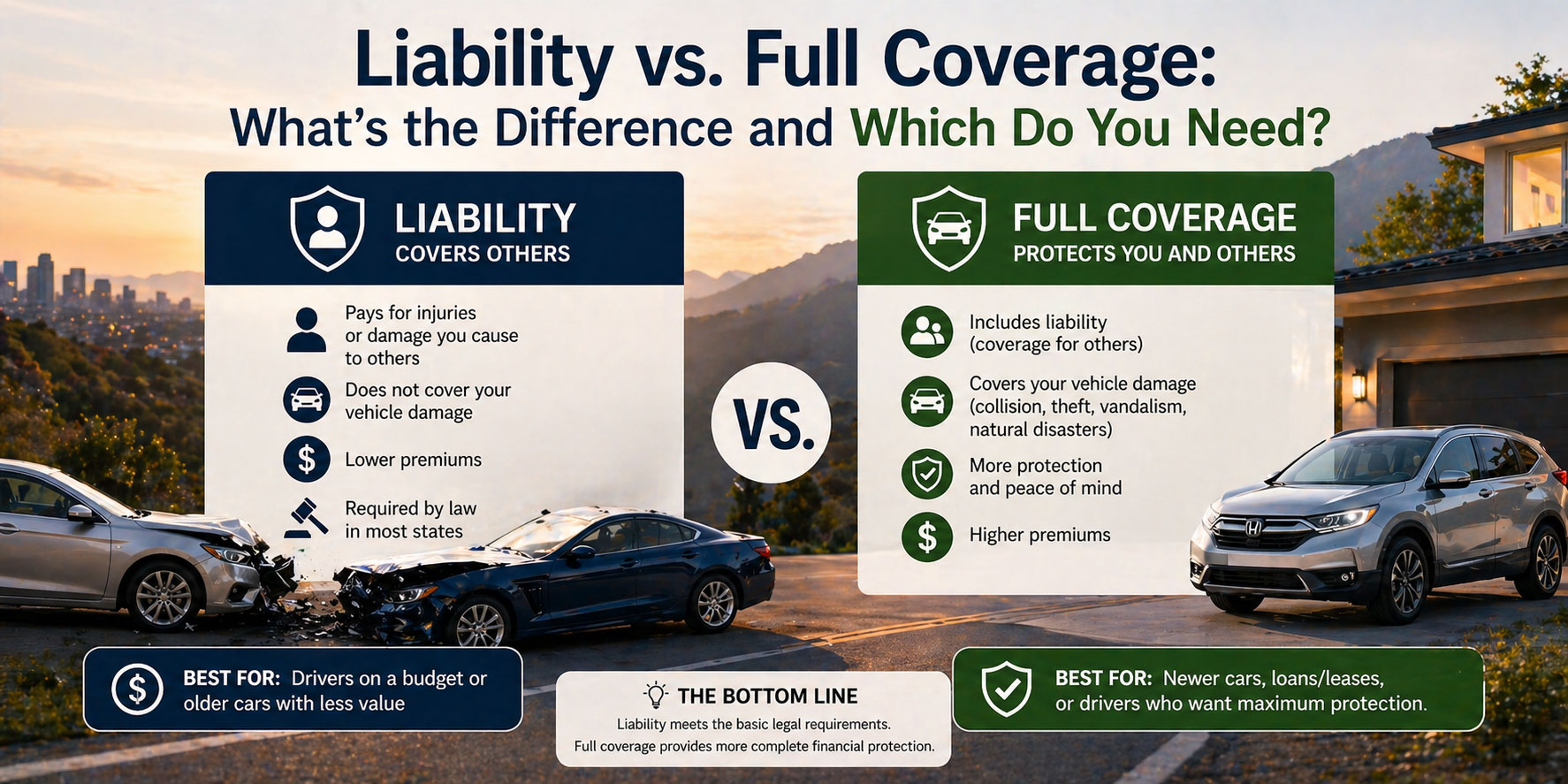
Liability coverage is the minimum required by law in most states. Full coverage goes further and protects your own vehicle in addition to others. Choosing between them affects how much you pay each month, how much protection you have after an accident, and whether your lender will approve your financing.
If you are trying to figure out which option fits your situation and budget, you can compare quotes from multiple insurers at autoinsuranceplans.com to see real pricing side by side.
What This Service Includes
What Liability Coverage Is
Liability coverage pays for damage and injuries you cause to other people in an accident. It does not pay for your own vehicle or your own injuries. It is split into two parts.
Bodily injury liability pays for medical expenses, lost wages, and legal costs for other people injured in an accident you caused. Property damage liability pays to repair or replace other people’s vehicles or property you damaged.
Every state except New Hampshire requires some level of liability coverage. Minimum limits are set by state law, but those minimums are often too low to cover a serious accident.
What Full Coverage Is
Full coverage is not a specific policy type. It is an informal term that describes a combination of liability coverage, collision coverage, and comprehensive coverage together.
Collision coverage pays to repair or replace your own vehicle after an impact, regardless of fault. Comprehensive coverage pays for damage to your vehicle from theft, weather, fire, animals, and other non-collision events.
When people say they have full coverage, they mean all three of these are active on their policy.
What Is Usually Extra or Not Included
Neither liability nor full coverage automatically includes:
- Medical payments coverage or personal injury protection for your own injuries
- Rental car reimbursement while your car is being repaired
- Roadside assistance and towing
- GAP insurance to cover the difference between your loan balance and your car’s value
- Uninsured or underinsured motorist coverage in some states
These are add-ons that cost extra but can be well worth including depending on your situation.
Average Cost Overview
The cost difference between liability-only and full coverage is significant. Below are national average annual cost estimates for each option.
| Coverage Type | Typical Annual Cost |
| Liability only (state minimum) | $400 to $700 |
| Liability only (higher limits) | $600 to $1,000 |
| Full coverage (standard deductibles) | $1,200 to $1,900 |
| Full coverage (high-value vehicle) | $1,800 to $3,000+ |
These are national averages. Your actual cost will vary based on your state, driving record, vehicle, age, and the insurer you choose.
The low end of these ranges generally reflects drivers with clean records, older or lower-value vehicles, and states with lower average insurance costs such as Iowa, Maine, or Vermont. The high end reflects drivers in urban areas, those with recent claims or violations, young drivers under 25, and newer or more expensive vehicles.
Ready to see what you would actually pay? Use autoinsuranceplans.com to compare quotes from trusted insurance companies so you can find the right coverage at a price that works for you.
Key Cost Factors
Several variables determine where you fall in these price ranges.
- State requirements. Each state sets its own minimum liability limits. States like Michigan and New York have higher required minimums and higher average premiums than states with lower minimums.
- Coverage limits you choose. Higher liability limits cost more but protect you better if you are sued after a serious accident. Minimum limits can be exhausted quickly by a major injury claim.
- Deductible amount. For collision and comprehensive coverage within a full coverage policy, a higher deductible lowers your premium. A $1,000 deductible costs noticeably less per month than a $250 deductible.
- Your driving record. At-fault accidents and moving violations raise your premium for three to five years. A clean record earns you the lowest rates available.
- At-fault vs. no-fault states. In no-fault states such as Florida, Michigan, and New York, each driver’s own insurance pays for their medical expenses regardless of who caused the accident. Drivers in no-fault states are required to carry personal injury protection, which adds to the overall policy cost.
- Vehicle age and value. Collision and comprehensive coverage are priced based on what your car is worth. Newer and more expensive vehicles cost more to insure.
- Your credit score. In most states, insurers use credit-based insurance scores to help price policies. Drivers with lower credit scores typically pay higher premiums.
- Annual mileage. The more you drive, the more exposure you have to accidents. High-mileage drivers pay more than those who drive occasionally.
Ways to Save Money Without Cutting Corners
Understand What Is Required vs. Optional
Liability coverage is legally required in nearly every state. Collision and comprehensive coverage are optional unless your vehicle is financed or leased. If your car is paid off and has a low market value, dropping collision and keeping only liability and comprehensive may be a smart financial choice.
Compare Multiple Quotes
Premiums for the same driver and the same vehicle can vary by hundreds of dollars between insurers. Shopping at least three to five quotes at renewal is one of the most effective ways to lower your costs. Use autoinsuranceplans.com to compare options without filling out multiple separate applications.
Bundle Your Policies
Most insurers offer meaningful discounts when you combine your auto insurance with a home, renters, or condo policy. Bundling discounts commonly range from 5 to 25 percent off your auto premium.
Raise Your Deductible Thoughtfully
If you have savings to cover a higher out-of-pocket expense in an emergency, raising your collision deductible from $250 to $1,000 can reduce your collision premium significantly. Make sure you have the deductible amount accessible in case you need it.
Ask About Every Discount Available
Insurers offer discounts for many things: safe driving records, low annual mileage, completing a defensive driving course, insuring multiple vehicles, and having safety features like anti-lock brakes or anti-theft systems. Always ask what discounts apply to your profile.
Review Coverage Annually
Your coverage needs change as your car ages. If your vehicle has depreciated significantly, it may no longer make financial sense to pay for collision coverage. Review your policy each year and adjust accordingly.
Common Mistakes and Red Flags
Carrying only state minimum liability. Minimum limits are set low and often do not reflect the real cost of a serious accident. Medical expenses alone can easily exceed $50,000 or more. If your liability limits are too low, you can be held personally responsible for the difference.
Assuming full coverage means everything is covered. Full coverage still has gaps. It does not cover your medical bills, your personal belongings inside the car, or the gap between your loan balance and your car’s value after a total loss.
Dropping collision while the car is still financed. Your lender requires collision coverage for the life of the loan. Dropping it violates your loan agreement and can result in the lender purchasing forced-placed insurance at a much higher cost.
Not shopping around at renewal. Many drivers stay with the same insurer for years out of habit. Premiums can rise quietly at renewal without the driver realizing they could get better rates elsewhere.
Choosing a policy based only on price. The cheapest policy is not always the best value. Consider the insurer’s claims handling reputation, financial strength ratings, and customer service reviews alongside the price.
Not understanding the deductible before filing a small claim. Filing a claim for an amount slightly above your deductible can trigger a premium increase that costs more over time than simply paying out of pocket.
Frequently Asked Questions
Is liability coverage enough for most drivers? It depends on your situation. If your car is old and fully paid off, liability-only may be sufficient. If your car is newer, financed, or has significant value, full coverage better protects your investment.
What does full coverage actually pay if my car is totaled? It pays the actual cash value of your vehicle at the time of the loss, minus your deductible. Actual cash value accounts for depreciation and reflects current market value, not what you originally paid.
Do I need full coverage if my car is paid off? Not legally. But whether it makes financial sense depends on your car’s value and your ability to absorb the loss if the car is destroyed. If you could not easily pay to replace the car, keeping full coverage is wise.
What is the difference between a no-fault state and an at-fault state? In no-fault states, each driver files medical claims with their own insurer after an accident, regardless of who caused it. In at-fault states, the driver who caused the accident is responsible for the other party’s damages. No-fault states require personal injury protection coverage, which raises overall premiums.
Can I switch from full coverage to liability only at any time? Yes, as long as your car is not financed or leased. Contact your insurer and request the change. Be aware that you lose collision and comprehensive protection immediately, so make sure the timing is right for your situation.
Will my rates go up if I file a claim under full coverage? An at-fault collision claim will typically raise your rate at renewal. A comprehensive claim, such as hail damage or theft, usually has a smaller impact on rates. Frequency of claims matters more than any single claim in many cases.
How much liability coverage is actually recommended? Most insurance professionals recommend at least 100/300/100 limits, which means $100,000 per person for bodily injury, $300,000 per accident for bodily injury, and $100,000 for property damage. This provides much stronger protection than most state minimums.
Does full coverage include roadside assistance? Not automatically. Roadside assistance is usually an optional add-on. It is inexpensive and covers services like towing, jump-starts, and flat tire assistance. Ask your insurer about adding it.